Top Salesforce AI Consulting Companies in 2026
A McKinsey survey shows that by 2025, 78% of companies use AI in at least one part of their business, up from 72% in 2024 and just 55% the year before. With AI adoption rising so fast, choosing the right Salesforce AI consulting partner has never been more important.
Businesses are increasingly looking for the expertise of Salesforce AI consulting firms to guide them through the complexities of implementing AI technologies. These firms not only help businesses identify the right AI solutions but also ensure that they are integrated effectively to optimize operations, enhance customer experiences, and drive growth.
In this blog, we’ll explore some of the top Salesforce AI consulting companies known for their innovation, expertise, and impact.
Salesforce AI Consulting Companies
These companies specialize in helping organizations deploy AI strategies that align with their business goals. Whether you’re looking to automate processes, enhance decision-making through data analytics, or innovate with machine learning models, partnering with a top Salesforce AI consultancy can make the difference between success and failure.

These firms bring expert knowledge, access to cutting-edge tools, and valuable industry insights to deliver tailored AI solutions.
1. Accenture AI
Key Highlights:
- Global Leader with over 9,000+ Salesforce-certified experts and 40,000+ Salesforce-skilled professionals.
- Delivered 1,000+ Salesforce implementations across industries including finance, healthcare, retail, and manufacturing.
- Co-launched the Generative AI Acceleration Hub with Salesforce to fast-track Einstein GPT use cases.
- Runs a dedicated Generative AI & LLM Center of Excellence for AI strategy, accelerators, and frameworks.
- Offers tools like the Customer 360 Value Meter to track AI-driven business impact.
Why It Stands Out:
- Combines AI, data, and Salesforce for large-scale transformation.
- Known for early access to Salesforce AI features and industry-specific accelerators.
- Strong focus on user adoption, change management, and delivering measurable ROI.
2. Deloitte AI Institute
Key Highlights:
- Salesforce Global Strategic Partner for 15+ years with thousands of implementations.
- Leads with “Agentic AI”- deploying intelligent agents to automate workflows and decisions.
- Offers Agentforce Accelerators tailored for industries like finance, life sciences, energy, and public sector.
- Runs the Agent Advantage program with pre-built AI agents to speed up deployments.
- Backed by the Trustworthy AI™ framework for ethical, compliant, and secure AI use.
Why It Stands Out:
- Strong in regulated industries, focusing on governance and data quality.
- Blends strategy with technical delivery, from boardroom advisory to implementation.
- Known for scalable AI agents that enhance workforce productivity—not replace it.
3. IBM
Key Highlights:
- Salesforce Summit Partner with AI depth via Watsonx and Granite large language models.
- Expanded 2024 alliance with Salesforce for Einstein 1 Platform integration and Zero Copy Data sharing.
- Enables flexible AI model selection—clients can use IBM or third-party LLMs in Salesforce.
- Offers AI-driven solutions in customer service, sales automation, and predictive analytics.
- Internal use case: IBM reduced support case resolution time by 26% using Salesforce + Watson.
Why It Stands Out:
- Combines AI, data integration, and Salesforce under one roof.
- Strong fit for complex, data-heavy enterprises with stringent compliance needs.
- Known for trusted, open AI frameworks and deep domain-specific LLMs.
4. Capgemini
Key Highlights:
- Salesforce Summit Partner with deep focus on Customer Experience (CX) transformation.
- Introduced the Generative AI for CX Foundry to deploy AI across the customer journey.
- Covers Sales, Service, Marketing, and Industry Clouds with industry-specific expertise.
- AI solutions include chatbots, personalized content, AI-assisted sales, and predictive service.
- Delivered AI-powered Salesforce solutions for clients like Heathrow Airport and major banks.
Why It Stands Out:
- Specializes in hyper-personalized, data-driven customer engagement.
- Offers pre-built templates and secure frameworks for fast, ethical AI rollout.
- Strong CX and AI integration for B2C and service-intensive industries.
5. Cognizant
Key Highlights:
- Salesforce Strategic Partner with one of the largest certified teams globally.
- Introduced Neuro AI Multi-Agent Accelerator to connect AI agents across platforms like Salesforce, ServiceNow, and SAP.
- Delivers Einstein GPT, Tableau CRM, and Salesforce Data Cloud integrations.
- Strong presence in life sciences, insurance, manufacturing, and public sector.
- Success stories include Saint-Gobain (25-country Salesforce AI rollout) and a U.S. state’s AI-driven fraud detection system.
Why It Stands Out:
- Pioneering cross-platform AI agent orchestration.
- Known for domain-specific AI accelerators and a co-innovation approach.
- Combines technical depth with agile delivery, especially for complex enterprise ecosystems.
6. Tata Consultancy Services (TCS)
Key Highlights:
- Salesforce Global Strategic Partner with strong AI and domain expertise.
- Launched Crystallus AI Accelerators for sectors like semiconductors, manufacturing, banking, and retail.
- 2025 offerings include:
Semiconductor Sales Accelerator
“Seller for the Future” AI Toolkit
Digital Field Service AI Solution
- Deep integration capabilities using MuleSoft and Tableau to unify and visualize data.
- Notable work with Telefonica, DuPont, and government agencies.
Why It Stands Out:
- Delivers pre-built, industry-aligned AI frameworks for rapid transformation.
- Known for data modernization, helping enterprises unlock siloed data for AI.
- Trusted for end-to-end delivery—from AI strategy to implementation and support at scale.
7. NeuraFlash
Key Highlights:
- Salesforce ISV and consulting partner focused exclusively on AI, automation, and Einstein GPT.
- Early mover in deploying Einstein Bots, Service Cloud Voice, and Field Service GPT.
- Offers voice + chat AI, GPT-powered assistants, and predictive service solutions.
- Integrates Salesforce with Amazon Connect for AI-driven contact center experiences.
- Notable wins in retail, financial services, manufacturing, and healthcare—including 50%+ automation in support channels.
Why It Stands Out:
- 100% focused on Salesforce AI and automation.
- Fast deployment with ready-made GPT accelerators and custom data models.
- Led by former Salesforce product leaders—giving clients early access to emerging features.
Also Read – How To Become an AI Consultant: A Complete Guide
How to Choose the Right Salesforce AI Consulting Firm
Selecting the right Salesforce AI consulting firm is crucial to ensure that your business harnesses the full potential of artificial intelligence. With numerous consultancies available, choosing one that aligns with your business objectives, industry, and specific needs can be challenging.
Below are several key factors to consider when choosing the right AI consulting firm:
1. Align Partner Strengths with Project Scope
- Enterprise-wide transformation? Opt for large partners like Accenture or Deloitte, which offer end-to-end Salesforce + AI capabilities, program governance, and global scale (both have 9,000+ Salesforce-certified professionals).
- Targeted innovation? Specialized firms like NeuraFlash are ideal for building Einstein GPT-powered chatbots, AI for service ops, or custom AI use cases with faster turnaround.
2. Verify Salesforce Partnership Level
- Choose partners with Summit or Global Strategic status. These firms have deep technical expertise and early access to AI innovations like Agentforce or Einstein GPT accelerators.
- Example: Deloitte and Accenture co-innovated with Salesforce on industry-specific AI solutions.
3. Assess Proven AI Capabilities
- Look for certified AI specialists, data scientists, and documented use cases.
- Examples of real-world impact:
IBM cut support case resolution time by 26% using Watson + Salesforce.
Cognizant improved sales efficiency across 25+ countries for Saint-Gobain using AI-powered CRM.
4. Look for Industry-Specific Expertise
AI use cases vary by industry—ensure your partner knows your domain:
Deloitte: Financial services, public sector.
Capgemini: Aviation, e-commerce, retail CX.
TCS: Manufacturing and semiconductors.
Ask for industry benchmarks, accelerators, or compliance models relevant to your field.
5. Evaluate Accelerators & Methodology
Top partners bring pre-built accelerators to speed up implementation:
TCS Crystallus AI for manufacturing and field service.
Deloitte’s Agentforce library for rapid AI agent deployment.
Ensure their delivery model includes agile phases, user training, and AI model tuning post-launch.
Also Read – Top AI Tools for Consultants
6. Balance Scale vs. Agility
- Large programs: Go with IBM, Accenture, or TCS for access to hundreds of consultants and full-stack services (ERP, AI, change management).
- Agile projects: Choose NeuraFlash for speed, creative AI prototyping, and dedicated attention.
- Consider hybrid models: e.g., Accenture for CRM rollout + NeuraFlash for AI chatbot layer.
7. Prioritize Business Value and Adoption
- Ask partners to define KPIs up front—e.g., cost reduction, CSAT, lead conversion.
- Example: IBM reported 25-point NPS increase and 45 mins/day saved per agent post-AI rollout.
- Check if they offer user enablement: workshops, AI champions, post-go-live refinements.
8. Demand Responsible AI Practices
Ask how they handle:
Data privacy (especially for finance/healthcare)
Bias testing in AI models
Regulatory compliance (e.g., GDPR, HIPAA)
Firms like Deloitte, IBM, and Capgemini follow frameworks like Trustworthy AI or Open & Trusted AI for risk mitigation and governance.
9. Transparency in Pricing and Project Timelines
Lastly, transparency in pricing and timelines is essential for a successful consulting partnership. AI projects can range from small pilot implementations to large-scale digital transformations, and having a clear understanding of the costs involved, as well as realistic project timelines, helps prevent scope creep and unexpected expenses.
The consulting firm should provide a clear breakdown of costs and outline how long each phase of the project will take.
The Role of Top AI Consulting Firms in Building Ethical AI Systems
AI ethics has become a cornerstone of responsible AI implementation. Consulting firms are taking on the critical responsibility of ensuring AI systems are fair, unbiased, and aligned with societal values. These firms focus on creating ethical frameworks that guide businesses in deploying AI while maintaining trust, compliance, and transparency.
Ethical AI begins with responsible data practices, ensuring diverse and unbiased datasets are used to train AI models. Consulting firms work closely with businesses to audit data sources, identify potential biases, and design algorithms that minimize discrimination. Additionally, they implement robust AI governance structures to ensure continuous monitoring and improvement of AI models.
Another essential aspect is regulatory compliance. AI consulting companies stay updated on global regulations such as GDPR, HIPAA, and emerging AI policies. They integrate these requirements into AI projects to help organizations avoid legal challenges and reputational risks.
Beyond technical solutions, consulting firms emphasize education and awareness. They train employees on ethical AI practices, fostering a culture of accountability and understanding. Through their efforts, businesses not only achieve innovative AI solutions but also ensure their AI initiatives positively impact customers and communities.
Conclusion
Top AI consulting firms play a vital role in helping businesses navigate the complexities of implementing artificial intelligence. Whether you’re looking to automate processes, enhance customer experiences, or gain insights through data analytics, the right consulting firm can guide you toward success. The companies listed here offer the expertise, technology, and innovation needed to unlock the full potential of AI for your business.
Making a choice is easier when the process is clear.
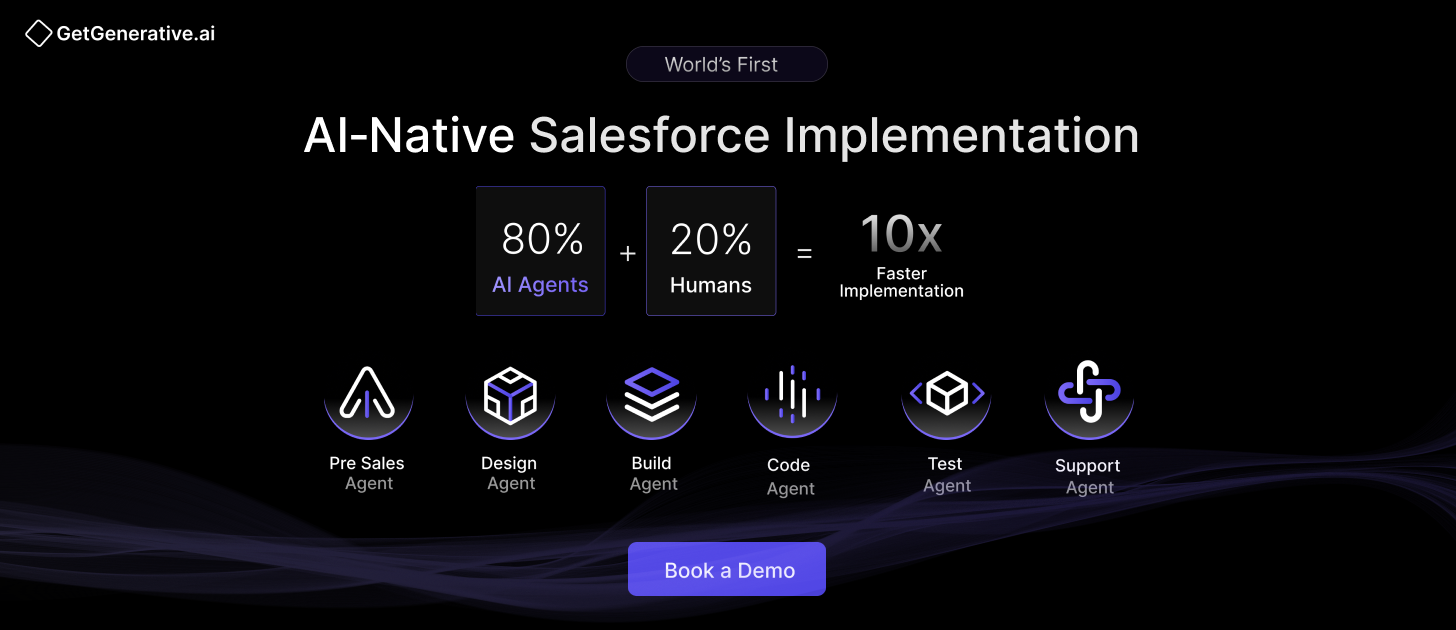
GetGenerative.ai brings everything you need to manage Salesforce implementation—from first proposal to go-live—into one AI-powered workspace. Whether you’re shaping scope, planning resources, or coordinating across teams, our agents are built to keep things moving, thoughtfully and efficiently.
👉 Explore our Salesforce AI consulting services